
Working Together to Better Understand and Improve Mental Health Care Environments
Introducing the Design in Mental Health Network – North America
📅 Monday, October 26, 2026
🕑 2:00–3:00 PM EDT
💻 Online webinar
Because every environment communicates something.
- You are valued.
- You are safe here.
- You have choices.
- Your needs have been considered.
- You belong.
What changes when we bring different perspectives together from the beginning?
Creating better mental health care environments is not the responsibility of any one profession.
People with lived experience understand these environments in ways that designers cannot.
Clinicians and caregivers see how spaces affect care, relationships and everyday practice.
Designers, researchers, facilities teams, operators, manufacturers and policymakers each bring different knowledge, priorities and constraints.
The challenge is not simply getting those perspectives into the same room.
It is learning how to work with them.
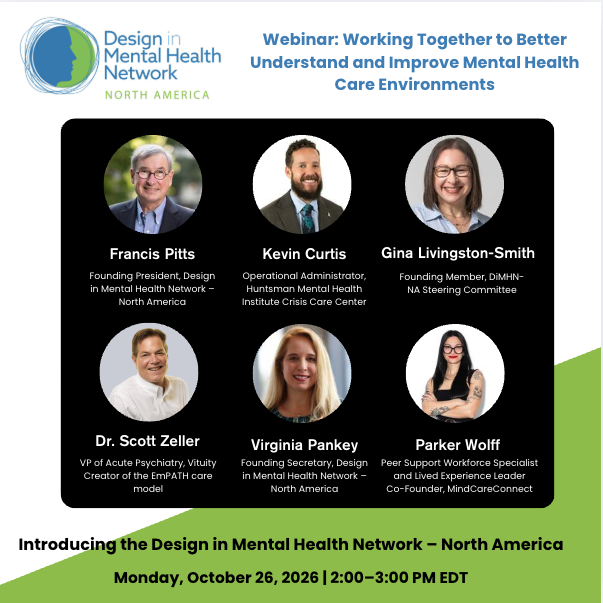
This webinar from the Design in Mental Health Network – North America (DiMHN-NA) brings together six people working across lived experience, crisis care, mental health care, operations, architecture, interior design, peer support and standards development.
Together, they will explore what becomes possible when we move beyond consultation and toward genuine co-design and co-production.
Because better mental health environments do not begin with one discipline having all the answers.
They begin with people being willing to understand the problem together.
Why this conversation matters
Safety matters.
So do dignity, autonomy, human connection, operational effectiveness, evidence, individual experience, and an environment’s ability to support healing and recovery.
Those priorities do not always align neatly.
Different people may see the same design decision very differently depending on their professional expertise, personal experience or role within a care environment.
That is precisely why collaboration matters.
The question is not how to remove those different perspectives.
It is how to use them better.
How do we distinguish genuine co-production from consultation?
How does co-design differ from co-production — and where does each belong?
How do lived experience and professional expertise inform one another without treating one as automatically more important than the other?
How do project teams work through competing priorities without losing sight of the people who will ultimately experience the environment?
And when almost everything on a project can be described as important, how do we identify what is genuinely essential?
These are some of the questions we will explore during this session.
What you’ll gain
By the end of the webinar, attendees will have explored:
- The difference between co-design and co-production, and the role each can play in developing models of care and care environments
- How personal, lived and professional perspectives can reveal different priorities within the same project
- Ways of using those perspectives to inform practice and strengthen multidisciplinary project teams
- Why productive collaboration is about working with difference rather than simply seeking consensus
- How to distinguish what is important from what is essential when creating supportive mental health care environments
- Why the environment needs to be understood as part of the experience of care, rather than simply the place in which care happens
- The thinking behind the newly established Design in Mental Health Network – North America (DiMHN-NA)
- How DiMHN-NA hopes to connect lived experience, care, design, research and industry perspectives to improve mental health environments across North America
The conversation
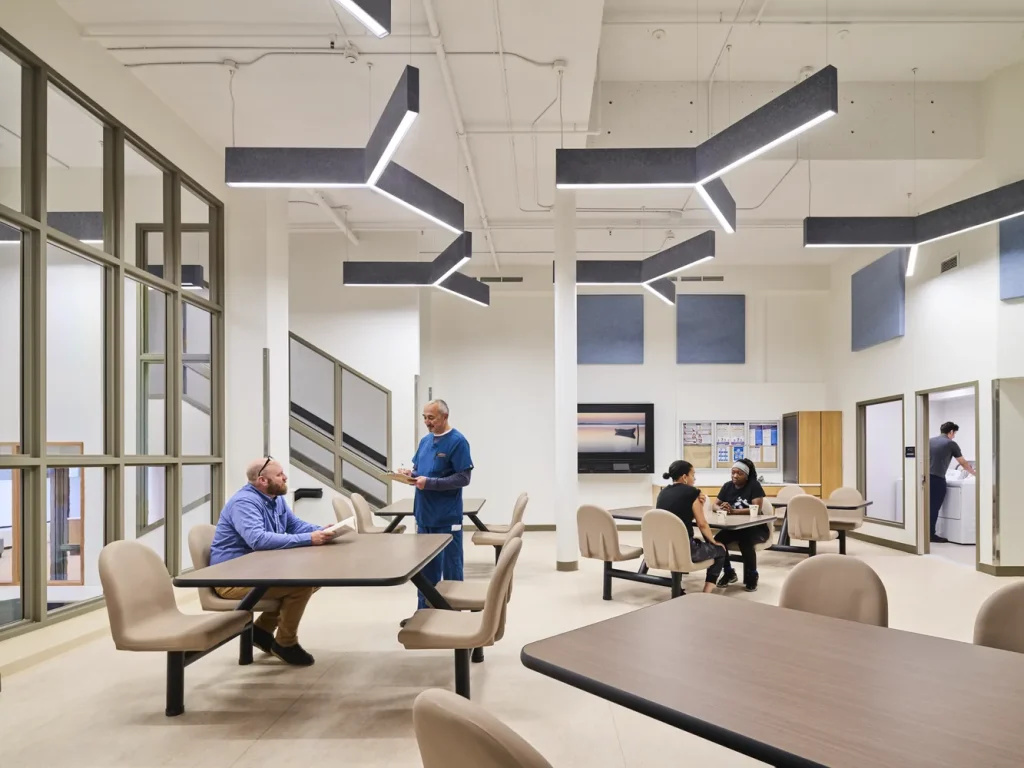
A person experiencing a mental health crisis may understand a room very differently from the person delivering care within it.
An architect may see an opportunity for openness and connection.
A clinician may identify an operational or safety consideration.
A person with lived experience may notice something entirely different: whether they feel watched, welcomed, respected, restricted, calm or able to retain some sense of control.
None of those perspectives exists in isolation.
Good decisions emerge when teams can understand what sits behind them.
During the webinar, our speakers will draw on experiences ranging from the planning and design of mental health facilities to psychiatric emergency and crisis care, operations, interior environments, standards development, peer support and lived experience.
The aim is not to present one universal answer.
It is to improve the questions we ask, and the way we work together to answer them.
Who should attend?
This webinar will be particularly relevant to:
- People with lived experience involved in improving mental health services and environments
- Peer support professionals and lived experience leaders
- Mental health clinicians and care teams
- Caregivers and family advocates
- Health care architects and interior designers
- Facilities, planning, capital and operational leaders
- Researchers and academics
- Health system leaders
- Manufacturers and suppliers working in mental health environments
- Students and emerging professionals
- Policymakers and others involved in shaping mental health care
- Anyone interested in the relationship between mental health, human experience and the built environment
Whether you work directly in mental health care or bring expertise from another part of the system, this session invites you to consider what your perspective contributes, and what may become visible when it comes together with others.
Our Speakers

Francis Pitts — Moderator
Founding Principal, architecture+, Founding President, Design in Mental Health Network – North America
Francis Pitts is the Founding Principal of architecture+ in Troy, New York, and has spent his career planning and designing mental health care environments.
He has consulted on more than 200 projects involving more than 25,000 mental health beds across the United States and Canada and has long advocated for evidence-informed design in mental health care.
His contributions have been recognized with The Center for Health Design’s 2018 Changemaker Award, the Healthcare Facilities Symposium & Expo’s 2022 Founder’s Award, and the American College of Healthcare Architects’ 2024 Lifetime Achievement Award.
Francis is the founding President of the Design in Mental Health Network – North America and will moderate this multidisciplinary conversation.

Dr. Scott Zeller, MD
Vice President of Acute Psychiatry, Vituity, Creator of the EmPATH care model
Dr. Scott Zeller is a psychiatrist and the creator of the EmPATH (Emergency Psychiatric Assessment, Treatment and Healing) model, which reimagines how people experiencing a psychiatric emergency can be supported in a more therapeutic environment.
Over a three-decade career, Scott has advised more than 200 hospitals, universities, mental health systems and government agencies across the United States. His work brings together clinical innovation and environmental design, with a focus on providing timely, compassionate crisis care in settings designed around the needs and experiences of the people using them.
More than 60 EmPATH units now operate across the United States. Scott has made the model freely available for organisations seeking to improve psychiatric emergency care and the environments in which it is delivered.
He is also Past-President of the American Association for Emergency Psychiatry and the National Coalition on Psychiatric Emergencies, and has written and lectured extensively on improving emergency psychiatric care.
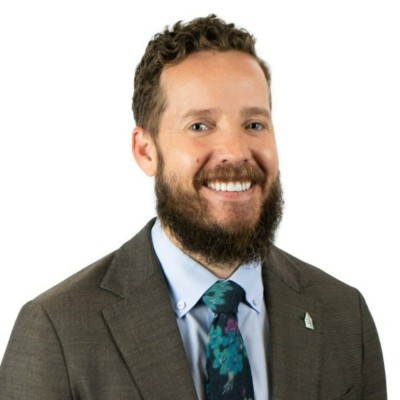
Kevin Curtis
Operational Administrator, Huntsman Mental Health Institute Crisis Care Center
Kevin Curtis has worked in mental health care for 20 years across clinical and administrative roles.
He is passionate about creating efficient, evidence-informed, and human-centered access to care for people experiencing mental health crisis.
Kevin is the Operational Administrator for the Huntsman Mental Health Institute Crisis Care Center, an 80,000-square-foot continuum of care for people experiencing mental health crisis.
He is also a member of The Center for Health Design’s Behavioral and Mental Health Environment Network and has been an early advocate for the Design in Mental Health Network – North America.

Gina Livingston-Smith
Senior Designer, Interiors, HDR, Founding Member, DiMHN-NA Steering Committee
Gina Livingston-Smith is an award-winning interior designer at HDR with more than 20 years of experience in health care planning and design.
Her work focuses on evidence-informed, human-centered environments that support healing, safety, and well-being, with particular expertise in mental health settings.
Gina is a recognized industry speaker, a founding member of the Design in Mental Health Network – North America Steering Committee, a member of The Center for Health Design’s Behavioral and Mental Health Environments Network, and an adjunct faculty member at Kent State University, where she mentors future health care designers.

Virginia Pankey
Behavioral Health Practice Leader, HOK Founding Secretary, Design in Mental Health Network – North America
Virginia Pankey is HOK’s Behavioral Health Practice Leader and believes that thoughtful planning can play an important role in supporting healing outcomes.
A frequent speaker at health care design conferences, the EmPATH Summit, and the National Update on Behavioral Health Emergencies, Virginia is actively involved in developing industry guidance and standards.
Her work with the FGI Health Guidelines has included chairing the Behavioral Health Crisis Unit topic group for the 2022 edition and co-chairing the Behavioral and Mental Health topic group for the 2026 edition.
Virginia is the founding Secretary of the Design in Mental Health Network – North America.

Parker Wolff
Peer Support Workforce Specialist and Lived Experience Leader Co-Founder, MindCareConnect
Parker Wolff is a nationally recognized peer support workforce specialist and lived experience leader.
She was named the 2024 SAMHSA STAR Peer Support Worker of the Year, becoming the award’s inaugural recipient.
With more than a decade of experience developing peer support programs within state psychiatric hospitals, Parker brings together firsthand experience of psychiatric care and extensive institutional knowledge.
She is Co-Founder of MindCareConnect, an international speaker on peer workforce development and the value of lived experience as professional expertise, and has been actively advising founding members of the Design in Mental Health Network – North America Board.
Register
📅 Monday, October 26, 2026
🕑 2:00–3:00 PM EDT
💻 Online webinar
Come ready to listen, question, and contribute.
Better mental health environments require different kinds of expertise.
The opportunity lies in what happens when we bring them together